A healthy tear film keeps the ocular surface moist and protected. If there is too little tear fluid or it has the wrong composition (dry eye), or if the tear drainage ducts are narrowed, the ocular surface suffers permanently.
When you should see us
- sticky, greyish or yellowish mucus in the eye
- a chronically watering eye without any visible injury
- already visible clouding or pigmentation of the cornea, especially in short-nosed breeds
What we examine
With the Schirmer tear test we measure tear production to reliably diagnose dry eye. If a narrowed tear drainage is suspected, we check and flush the tear ducts.
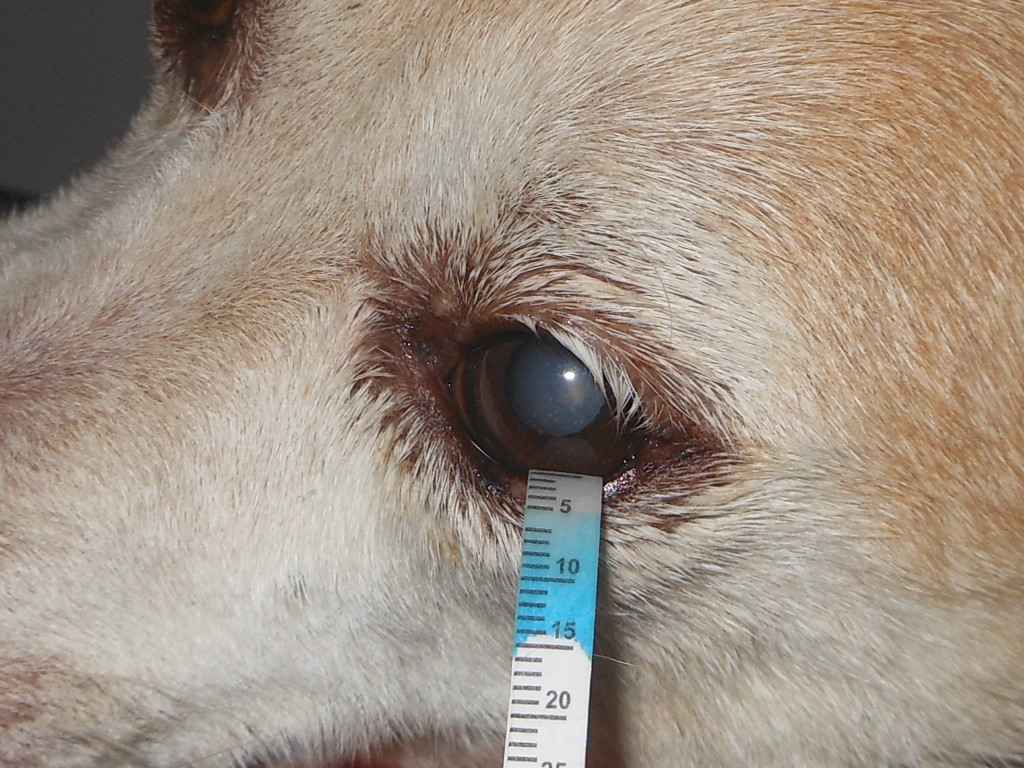
Schirmer tear test: a paper strip in the lower eyelid measures how much tear fluid is produced.
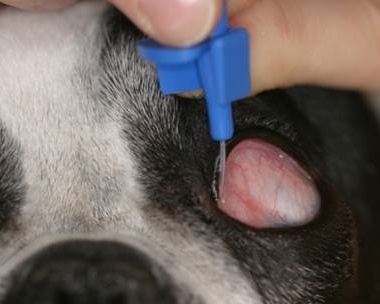
Checking the tear ducts: a fine probe is used to check whether the tear drainage ducts are open.
Treatment
In most cases dry eye is treated long term with eye drops that improve the tear film. Narrowed tear ducts can be gently widened and flushed with a fine probe; in some cases a small, permanently placed catheter makes sense. For very severe dry eye that cannot be adequately controlled with medication, surgery may be considered in individual cases, in which the duct of the parotid salivary gland is relocated so that saliva helps moisten the ocular surface (parotid duct transposition). This is an exceptional procedure that we only recommend after detailed consultation.