Changes to the eyelids, eyelashes or the third eyelid often rub directly on the sensitive cornea – the actual discomfort is then caused by this friction.
When you should see us
- an eyelid rolled inwards or outwards (entropion/ectropion)
- a visible swelling or lump on the eyelid margin
- a red, bulging swelling in the inner corner of the eye (prolapsed third eyelid gland, commonly called “cherry eye”)
- persistent watering, squinting or rubbing despite normal-looking eyelids – often a tiny, hidden eyelash is behind it
- in short-nosed breeds such as Pugs or French Bulldogs: chronic eye discharge or dark discolouration of the cornea
What we examine
During the examination we carefully pull forward the third eyelid to check whether a foreign body, a hidden eyelash or a change to the third eyelid gland is hiding behind it.
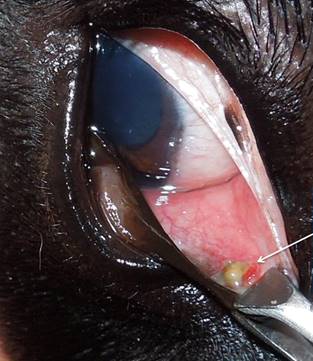
A foreign body behind the pulled-forward third eyelid – easily missed without looking behind it.
Treatment
Most of these changes can be corrected well surgically – the aim is always the function of the eye, not cosmetics:
- correction of an inward- or outward-turned eyelid
- removal of eyelid margin tumours with a special suture that smoothly rejoins the eyelid margin
- finding and removing hidden eyelashes (ectopic cilia) under the operating microscope
- repositioning a prolapsed third eyelid gland so that it keeps its function for the tear film
- in short-nosed breeds: surgical narrowing of the eyelid opening (medial canthoplasty) so that the eye is better protected in the long term
What a hidden eyelash can look like and do is shown in our real patient story Ein verstecktes Haar war’s! (in German).